Title here
Summary here
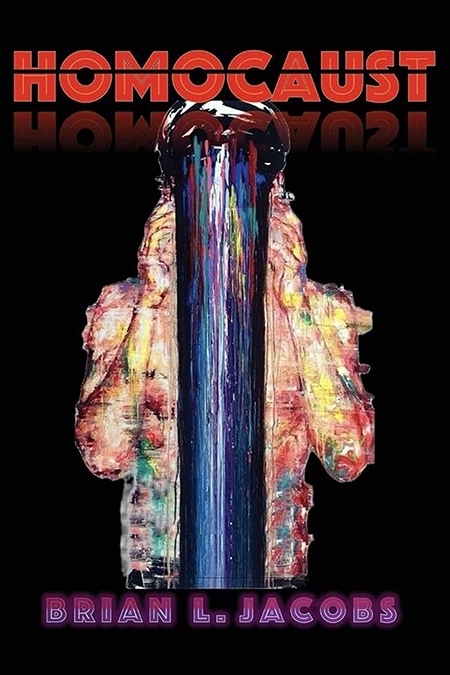
[I]n the shadow of the beats. In his poem ‘a consultation with dirt’, from the collection Homocaust (Jacobs 2025), Brian L. Jacobs chooses to go all lower-case even when mentioning his inspirational forebears of Ginsberg and Kerouac. Jacobs worked closely with Ginsberg as teaching assistant during his time earning his MFA at Naropa University in Colorado; of course, this was the paradigmatic first Western Buddhist University. As such (and not without its controversies), this was an experiment in fusing West and East, just as Kerouac himself had sought with his ‘American Haikus’ concept. The university originated and still houses the Jack Kerouac School of Disembodied Poetics for the study of poetry and culture. For me, at least, in reading Homocaust, this is one of the book’s main contextualisations. Brian L. Jacobs is continuing, in his own singular manner, this counter-culture of the Beats, perhaps the neo-Beats, through his background teaching work in San Francisco, the evolution of his press, Tofu Ink Arts, as a publisher, and now a move to Ann Arbor in Michigan (as well as a new Columbia University qualification in publishing). Brian is a kind of Superman in the world of independent small presses: fully irrepressible.
Jacobs refers to himself as a ‘Rhizomatic’ poet, invoking that seminal Deleuzian-Guattarian concept of rhizome to signify differentiated roots and plural trajectories of literary flight. He has a new academic text, Rhizomatic Poetics, forthcoming with Routledge, which will allow us a theoretical angle on his writings. Homocaust itself, as an enactment of the poetry rather than the poetics, challenges us to make some interpretative leaps in understanding the text. Homocaust carries a vivid neo-Beat ethos alongside related but distinct identities and allegiances. Donald Allen’s New American Poetry signalled the emergence in 1960 of the holy trinity of American poetics: the Kerouac crew alongside the Black Mountain folks like Robert Creeley and, of course, the New York School of O’Hara and Ashbery.
There were all different as schools (perhaps anti-schools, as the designations are always somewhat arbitrary, if useful), but certainly as individual poets, too. The urbanity of O’Hara is a world away from the more cerebral Parisian inflected urbanity of Ashbery, yet they share an aesthetic, for the most part; terse, rhythmic, and that movement between high culture and low culture acts as an enjoyable poetry in and of itself. Jacobs’ poetry sits alongside these earlier poetics quite naturally, although his vision is clearly more contemporary and perhaps somewhat wiser (after the fact, 20/20 insights in the rear-view mirror). His Rhizomatic Poetics puts into play ‘an unrooted pilgrim’ and an exploration and experimentation of ‘diverse self-experiential contexts’ (Jacobs 2025: v), with the view to what Tofu Ink calls an ‘absorption of possibilities’. There is an authentic personal reference point here for Jacobs, with his ‘Peace Pilgrimage’ walk with Buddhist monks around the globe in 1994-95 being one of the sources of the inspiration for Homocaust.
The book is divided into three main sections, and extends to over 450 pages, thus my review will be selective. The Preface describes the reader as ‘a pilgrim writer through interpretation’, with both writer and reader ‘filling in elliptical meanings’ (Jacobs 2025: v). Opening with a Rhizomatic Prayer, ‘step into this body of peace/an isle of exile addicted to violence’ (Jacobs 2025: 3), there is a strong vision emergent through these pages of an Arts Education and a Poetics which can enact some kind of healing for those who read and write in a world that can otherwise seem meaningless and nihilistic. This reminds me of fellow American poet bell hooks who speaks of pedagogy as a ‘spiritual healing’. Melinda Smith has referred to this poetics as ‘an incantation to the decolonisation of the self’ and it is this deconstruction of the structures of the ego, which is operationalised, again and again, across this mammoth text: ‘for I am not a clock/but intricate hopscotch’ (Jacobs 2025: 15).
This decolonisation is also an affirmation of queer identity and queer poetry – ‘queer clarity skipping rope’ (Jacobs 2025: 9), while the hegemonic culture (of heteronormativity, presumably) seeks to ‘dequeer . . . [to] unfaggot me’. Clearly, the hegemonic hetero- culture has little success in this regard with the explosive resistance of this rhizomatic poetic theatre. At different times, those paradigms of the French postmodern philosophy avant-garde, Bataille + Derrida + Foucault (each of course adding something distinct and different to the mix) are invoked as precursors (Jacobs 2025: 20) and inspirers.
That 1960s explosion of gay liberation contra hateful homophobia leads into the later LGBTQ+ transfiguration of the politics of identity and of poetics which continues apace today, albeit being fought so much against a resurgent Far Right, Religious Right and Alt-Right. In this, Homocaust is also an inheritor of the Anti-Fa of the New American Poetry. Josef Albers had to flee Berlin and his seminal work at the Bauhaus School to escape the fascism of the Nazis to land in the North Carolina of the Black Mountain School. Perhaps this philosophy of anti-fascism is the kernel of the ethos of each of these emergent schools of poetics in the 1950s, 1960s and beyond (the notion of Anti-Fa is also very urgent in the present moment, showing the prescience but also the relevance of these resources for the newest generation of young artists and thinkers). ‘This be our new universe, going to class with Josef Albers / School is out except for thinking and being like this / slantwise (Irwin 2026).
Jacobs enacts this ‘slantwise’ poetics ad infinitum in the text; although there is ’no totality/queer’ (Jacobs 2025: 39), there is a progressivist dialectic at work here, both poetic and philosophical. There is a working through of the trauma of hatreds historically directed at gay and queer people (‘Stonewall’ 1969 is a constant reference point for LGBTQ+ poetries) but these culture and (anti-)sex wars are hardly over; we are effectively living through these ominous times again in 2026, like some kind of Nietzschean Alt-Right Return of the Repressed. Homocaust as a text confronts this repression machine full on frontal, ‘cross furrows rough ended in screams/people with AIDS up in flames’ (Jacobs 2025: 82). This architectonic of oppression – a kind of pedagogy of queer oppression – is played out in the text with an obsessive reference to a Tormentor Archetype, L’More (Jacobs 2025: 118) who keeps destroying and undermining any chance or hope of l’amour, or authentic love relations. This can be personal as in ’the Homocaust is in my heart / everything about me has been used against me’ (Jacobs 2025: 373), or also more political: ‘FUCK YOU AIDS’ (Jacobs 2025: 386).
And the antidote? ‘[T]ime for Rhizomatic poetics / flint’s tool kits for heretics’ (Jacobs 2025: 89). This progressivism brings a more vivid and voracious (even lascivious) ethos – ‘Viva L’Rectum’ (Jacobs 2025: 131). The last section of the book in particular rhapsodically takes us as readers towards a more enlightened self-awareness and social consciousness, rooted in an Eastern (Buddhist) vision of ‘peace’ which once more connects to that counter-cultural tradition from Snyder through Kerouac and Ginsberg to Naropa and beyond. If there is religion here in the poetry, it is heterodox and anti-empire: ‘spinning khadi against empire / singing prayer liberationally’ (Jacobs 2025: 448). One of the epigraphs of this final section – entitled ‘Homocaust Pilgrimage’ – is from Dutch Jewish Holocaust victim Etty Hillesum and the latter part of the text aligns the hatred of queerness with the anti-semitism and the genocides of Nazism. ‘Ultimately, we have just one moral duty; to reclaim large areas of peace in ourselves, and to reflect it towards others. And the more peace there is in us, the more peace there will also be in our troubled world’ (quoted Jacobs 2025: 398). This text is an extraordinary neo-Beat / neo-Hedonist call not to arms, but to Peace, and the wildness and gorgeousness of its vivid and fervid poetry is in the end, despite the in-dwelling on the deep pain and suffering of existence, an affirmation of Life as a force for good.
Irwin, Jones (2026) Olson at Black Mountain Sonnet. Red Ogre Review, Los Angeles.
Jacobs, Brian L. (2025) Homocaust. Tofu Ink Arts Press, San Francisco.
Jones Irwin teaches Philosophy and Education in Dublin, Republic of Ireland. He has published poetry most recently in Espacio Fronterizo (Borderland / Espace Frontière), Moonstone Press, and Tofu Ink Arts Press. He is resident Poetry Critic and Columnist with Red Ogre Review, where he publishes a series of short texts on poetics. His first chapbook of poems, entitled GHOST TOWN, was published by Moonstone Press, Philadelphia, in later Summer 2022. His second chapbook of poems, entitled American Haikus, was published in Summer 2024, also with Moonstone Press. His first full-length book of poetry and prose, entitled Deep Image, was published by Tofu Ink Arts Press, San Francisco, in October 2025. His second full length book of poetry and prose, entitled More American Haikus, is forthcoming from Moonstone Arts Press in later 2026. This is a triptych of three new and original chapbooks written between 2025 and 2026, including More American Haikus, Aegean Poems, and Passionate Poems from the Margins of the Alt-Left.
Brian L. Jacobs, PhD, MFA, is Rhizomatic poet who grew up in Southern California and has been an educator for 35 years in both K–12 and college settings. He served as teaching assistant to Allen Ginsberg during his time earning his MFA. Brian is the founder of Tofu Ink Arts Press, where he has published dozens of books, and his own poetry has been published in several publications. He is the author of two books, one of poetry, Homocaust, and an academic text, Rhizomatic Poetics. Brian is a three-time Fulbright Scholar, a National Endowment of Humanities grant recipient, a Fund For Teachers fellow, taught teachers at a university in China for five summers as a SABEH fellow, and earned two Earthwatch grants studying climate change. Brian also participated in a peace pilgrimage walking from Poland to India. Now based in Ann Arbor, Michigan (publishing, writing and teaching college) he seeks to apply his editorial expertise to commissioning scholarly and creative humanities content.