I remember seeing Arthur Lee at the Ambassador Theatre in Dublin city centre (an extraordinary Art Deco music venue, originally a cinema, since sadly closed) in June 2002. Lee had just been released from an extended prison term on trumped up firearms offences and was in an emancipatory mood. A powerful set closed with ‘The Red Telephone’ as the small crowd and I surged to the front to sing the final refrain in unison with our anti-hero: ‘They’re locking them up today / They’re throwing away the key / I wonder who it will be tomorrow, you or me? / We’re all normal and we want our freedom / Freedom / Freedom / I want my freedom/ All of God’s children gotta have their freedom’.
Jon Savage has argued convincingly that Lee’s musical and lyrical vision in the band Love is one of the most important cultural documents of Sixties’ America and the wider world (as well as being prescient of what was coming down the line, ominously) (Savage 2001). At the heart of Lee et al’s originality was their giving the lie to an oft-repeated assumption about the hippie era’s naivete and idealism: ‘[the myth] that the hippies were hopelessly idealistic, stoned-out peace-and-loveniks: proponents of the flowah powah that wilted on its first exposure to external reality’ (Savage 2001). On a surface level, even the very band name (‘Love’, capitalised) seems to reinforce this flowah powah romantic myth, but then that would be precisely the barbed philosophical point. Instead, as Savage rightly argues, the vision of the album captures the duality of the structure of the then contemporary society, promising citizenry freedom and love whilst effectively prohibiting access to both through the ruses of capitalist ideology. ‘Nearly 34 years after its recording, Forever Changes remains a key, perhaps the key ’60s album: a perfect fusion of form and function that both defines and elegantly steps out of its time’ (Savage 2001).
Figure 1. Arthur Lee with the band (1967).
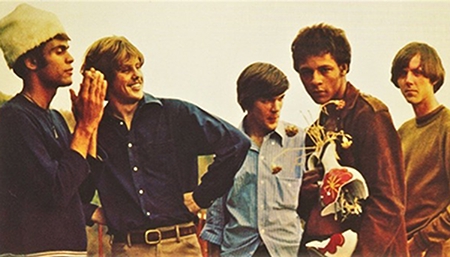
Both defines and steps out of its time. This doubling aspect is important in understanding the strengths and weaknesses of the Sixties’ ideology, as we look back on it from our vantage points in the here and now. The song ‘The Red Telephone’ itself starts with a very nonidealized image: ‘Sitting on the hillside / Watching all the people die / I’ll feel much better on the other side’. Opening track on the album, ‘Live and Let Live’ also channels the punitive and darker side of the free society, anticipating Lee’s own fate in the prison system literally, even if the incarceration here is primarily symbolic and spiritual : ‘Served my time / Served it well / You made my soul / A cell’.
Arthur Lee and Love take their place alongside that counter-cultural set of writers and thinkers who sought to debunk the so-called American Dream. In Kerouac’s paradigmatic On the Road (itself modelled on Homer’s Odyssey and Joyce’s Ulysses), for example, Sal Paradise announces; ‘rising from the underground, the sordid hipsters of America, a new beat generation’ (quoted Skerl 2004: 26). The lower-case writing captures the sense of both the subversiveness of this new emergent movement of resistance but also its inherent fragility in the context of the hegemonic social and existential system it sought to critique. Brian L. Jacobs in his recent text Homocaust (Jacobs 2025), when mentioning his inspirational forebears of Ginsberg, Kerouac, Corso etc., also goes lower-case: ‘and in the shadow of the beats / pilgrimaging into india’s samsaras / i can be a cypress tree / for i am not a clock / but intricate hopscotch’.
‘Hopscotch’ may be a reference to one of the most paradigmatic postmodern novels, Hopscotch by Argentine writer Julio Cortázar, published in Spanish in 1963. As with Lee and Forever Changes, there is a duality at work here too, between the vehement critique of oppression and the attempt to point a way to a more liberatory elsewhere. In Homocaust, the progressivist poetics seeks to work through the homophobic oppression and violence directed at queer and gay individuals and communities, ‘cross furrows rough ended in screams/people with AIDS up in flames’ (Jacobs 2025: 82). Arthur Lee in the ‘The Red Telephone’ points towards a elusive and potentially liberating ‘magic’; ‘I believe in magic / Why? Because it is so quick / I don’t need power when I’m hypnotized’.
Is it too much to see this as a connection to a kind of Magical Realism, where the late Sixties predicament can no longer be solved in socio-economic terms exclusively? As Octavio Paz, the Mexican Magical Realist notes, ‘we are facing problems (in late capitalism) that are no longer economic alone, but spiritual’. So too for Jacobs, in a related key, it is high ’time for Rhizomatic poetics/flint’s tool kits for heretics’ (Jacobs 2025: 89) and a more vivid and voracious (even lascivious) ethic – ‘Viva L’Rectum’ (Jacobs 2025: 131). Jennie Skerl, in her text Reconstructing the Beats (Skerl 2004) provides a strong contextualisation for this neo-Beat ethos, as she connects William Burroughs most especially (alongside Ginsberg and Kerouac himself) to a Latin American counter-culture of mysticism and Magical Realism: ‘pre-Columbian myths and symbols, a nonlinear approach to time; open or dialogical forms; a faith in drug induced insight; a turn to Eastern religions; and finally an imagery of nakedness and communion’ (Skerl 2004: 33).
This effectively ‘irrationalist’ dimension of the Beats is also delineated by Gilles Deleuze as the essence of Kerouac’s revolutionary methodology of literature, what Deleuze calls ‘minor literature’. The figure for this deconstructive but immensely creative process is the ‘Rhizome’ (Figure 2). Again, as part of this symmetry, Brian L. Jacobs refers to himself as a ‘Rhizomatic poet’, invoking this seminal Deleuzian-Guattarian concept of rhizome to signify differentiated roots and plural trajectories of literary flight (Jacobs 2025). What is stake here is the also the reconstruction of a counter-canon of writers and texts who and which have been wilfully neglected or repressed by the more centralised and top-down politics of literary production and reception. At one stage in his Homocaust text, Jacobs sets free a whole series of writers from this repression/oppression. As some examples – Henry Miller, Jean Genet, Kathy Acker, June Jordan (for the latter, see below).
Figure 2. A figuration of the Rhizome (per Deleuze) as a ‘deterritorialised’, non-hierarchical process of power.
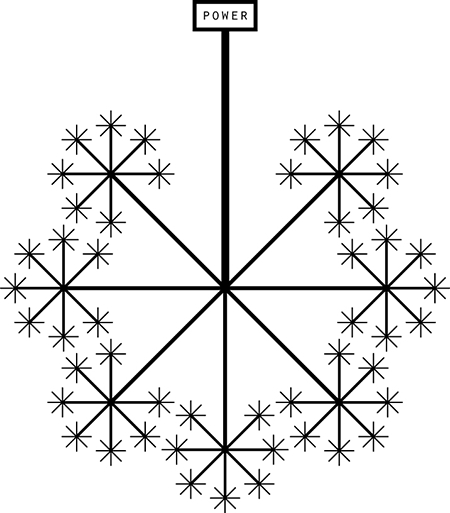
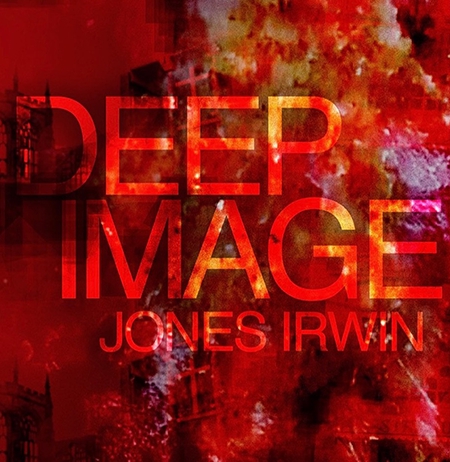
Similarly, in my own recent work in poetry and metafiction, I have sought to regenerate some aspects of that original Sixties counter-culture, through recourse for example to the ‘omni-poetics’ of Jerome Rothenberg (Irwin 2025). Rothenberg’s conceptualisation and putting into play of a notion of ‘Deep Image’ also calls us to develop what he terms an ‘Ethno-poetics’, a thoroughgoing pluralism and multi-culturality exploring oral traditions, rituals, and non-Western indigenous poetry. This has a strong resonance with Arthur Lee’s invocation of a ‘magic’ and a ‘hypnotism’ contra ‘power’. In my own text, Deep Image (Irwin 2025) (and working with Brian Jacobs and Joseph Lee in Tofu Ink Arts Press and their Neo-Beat ethos), I juxtaposed metafiction texts with prose poems, haikus and shorter verse. As for the connect to Rothenberg, my own practice as a philosopher brings me to seek out and to create texts which bear a relation to the complex human condition as a deeper presence restructuring the poem and poetics.
Figure 3. Deep Image cover art (Gemma Rose, Tofu Ink Arts Press, 2025).
As I argued there, ‘in our times of contemporary crisis, it is hoped that the writing of poetry and of poetics, as a kind of minor literature, might serve and supplicate as a surprisingly robust resource contra the banality of mainstream culture (whether Spotify, FB or worse), which draws out the genealogy of an ethical and aesthetic counter-culture all the way from the ancient culture of Bashō to our current malaise’ (Irwin 2025). The concept of ‘minor literature’ as noted above is itself a Gilles Deleuze innovation. In his reading of Kerouac’s On the Road, which Deleuze interprets as paradigmatic for a ‘Crack Up’ of more hegemonic values of Western (including French) literature, this new valuation of minor literature emerges as ’the revolutionary conditions for every literature within the heart of what is called great (or established) literature’. Minor literature proceeds by ‘a willed poverty, pushing deterritorialization to such an extreme that nothing remains but intensities’. It is precisely through such ‘intensities’ (in this case, textual or poetic intensities) that the more scattered roots of the rhizõma can break through the hard ground of the dominant ideology.
Thus, as with Arthur Lee, as with the Beats, as with Brian Jacobs, one can trace here the dual aspect of the problem; the critique of the contemporary malaise of culture and society alongside the attempt to point a way through to an alternative way of being: ‘I’ll feel much better on the other side’.
American Rhizõma
Maybe I’ve been listening
to too much Kramer and Bongwater
or mainlining The Butthole Surfers
but, comrades, this Orange Face era cannot go on forever
and us spiritual gardeners need to go digging for more rhizõma
just like ol’ Kerouacky when he looked and drove East
in his beaten-up Zephyr occultic magic car
and gave a lift to Cid Corman and Gary Snyder
those heroes of elsewhere but then Jack
under the inspire
brought it all back home here
that’s why Deleuze said he was a Crack Up
in ’60s Paris after the student riots burned at Nanterre
and Gilles was probably right sometimes madness
is the answer sometimes madness is the answer
Men who read June Jordan
are not phased by Juneteenth. Are especially upset by Juneteenth. As they can never be the woman that June was or continues to be. Her gender her posture her identity her rights, her rights over all men, to shout to rage to point revenge. For the crimes of the fathers, the sons and the boyfriends. Maybe even the sins of the daughters. Their chance too, the men, to shout full throttle back at June. That hate and conflict is no solution.
And yet.
Joe Hill Never Died
The Utah sky that foul November day
was extra grey, so depriving with its light.
At Sugar House Prison, they had tried to execute
the greatest living kin between Anarchism and
Poetry. But eternally from Greek Tragedy to the American Wobblies,
a recalcitrant Syndicalist fire burns in the belly. The police
death squad failed to understand this transfigurative power
of immortality. ‘I never died, said he’, sang Luke Kelly (Irwin 2026).
Figures
1.Arthur Lee with the band (1967).
2.A figuration of the Rhizome (per Deleuze) as a ‘deterritorialised’, non-hierarchical process of power.
3.Deep Image cover art (Gemma Rose, Tofu Ink Arts Press, 2025).
References
Irwin, Jones (2025) Deep Image. Tofu Ink Arts Press, San Francisco.
Irwin, Jones (2026) More American Haikus. Moonstone Press, Philadelphia.
Jacobs, Brian L. (2025) Homocaust. Tofu Ink Arts Press, San Francisco.
Jordan, Dervil and O’Hanlon, Jane (2025) Arts Education in Ireland: From Pedagogy to Practice. Intellect Books, Bristol.
Love (1967) Forever Changes. Elektra Records, Hollywood.
Rose, Gemma (2025) Cover art for Deep Image by Jones Irwin. Tofu Ink Arts Press, San Francisco.
Savage, J. (2001) Love: Forever Changes. MOJO, London.
Skerl, Jennie (Ed.) (2004) Reconstructing the Beats. Palgrave, London.