Back in 1986, I was a callow fifteen-year-old Dublin youth with a truly bad faux-spiky hairstyle and a line in black and green army surplus clothing, plus eighteen-hole Doc Martens that ran right up my long skinny legs and so many small, heartfelt tin badges of minor bands and causes. I was already running a vinyl and cassette distribution set-up (entitled Brain Dead Distribution) importing the punk underground into the Republic of Ireland from all over Europe. Soaped up stamps from UK anarchist groups kept getting me into trouble with the Post Office and my father who was, to make matters even better, in the Harcourt Terrace Vice Squad, had warned me that my connections with the Animal Liberation Front were drawing undue attention from his Special Branch comrades. I would look back on this time with full-on nostalgia, if my punk roots didn’t prevent me from indulging in such futile reverie.
Now that we are supposedly celebrating fifty years of punk rock, one is reminded that, for many, punk began in 1976 with The Damned and the Sex Pistols in cavernous London clubs. Both bands are touring their wares to celebrate and to cash in. Replacing John Lydon with the frankly awful Frank Carter is a bit like replacing Elvis with (a cheaply tattooed) Cliff Richard (no, I won’t be going to these gigs, thank you). For my generation of punkas [sic], punk was more likely to start around 1982 with the Leftist-Anarchist bands and collectives such as Crass and Conflict. This is the first point we could make in anger, drawing a clear distinction between the first wave of effectively celebrity punks and the later second generation wave of ethical-political anarcho-punks. This at least was my thinking in 1986, when I picked up my weekly NME from The Beanstalk newsagents in Edenmore, Northside Dublin. The issue gave me an option to send away for a cassette with the magazine, entitled ‘Pogo à Go Go’ (Figure 1).
Figure 1. Pogo à Go Go Cassette Cover (New Musical Express, 1986).
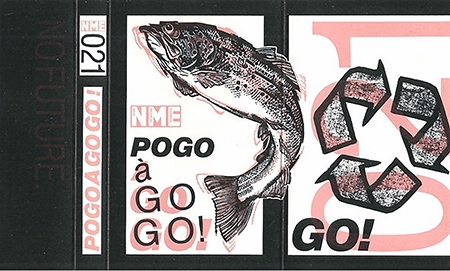
The ‘Pogo’ in the title refers to the very specific mode of dancing associated with the early punk movement. ‘A way of dancing that involves jumping up and down with the legs straight and close together, often to punk music (a type of fast, loud music that was originally popular among young people in the late 1970s)’ [Cambridge Dictionary]. This was one continuity between the first and the second generation of punks; we all pogoed like hell. But this rather off-beat cassette release also carried another more surprising continuity. The bands represented on this album, all from the very early days of punk in ‘76 and ‘77, were somehow not so far removed from the ethics and the artistry of the second generation. My small Dublin mind was blown, and I would have to reassess all my misguided purism and higher moral ground positionality.
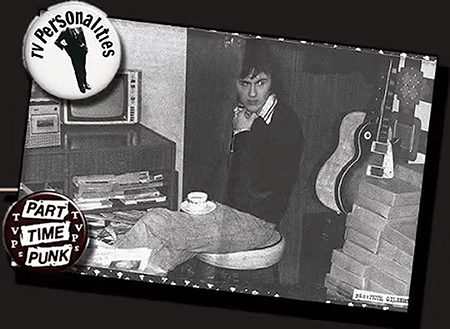
‘Pogo à Go Go’, dear reader, had it all. Dan Treacy’s Television Personalities set the (atonal) tone. Out of tune and with lyrics that seemed totally skewed, it would take me a while to realise that Dan Treacy was Jonathan Richman (but from Chelsea). The track ‘Part Time Punks’ on the cassette is probably my favourite, namechecking Treacy’s home neighbourhood of the King’s Road where he grew up but observed with a withering if lightly held rancour: ‘Here they come / La la la la la la/The Part Time Punks’. The ‘La la la la la la’ sounded completely incongruous to my fifteen-year-old ill-tuned ears, more like the Beach Boys or Showaddywaddy. It took me an inordinate while to realise that that was more or less the point. The money-shot came after: ‘They walk around together / And try and look trendy / I think it’s a shame / That they all look the same’.
Ooo, the ouch of that last rhyming couplet, ‘shame / same’, capturing the whole commodification and conformism of supposed youth revolution in a sharp aside. Whilst writing out a label to send a copy of the single to John Peel, for a joke Tracey listed the members of the band as famous television stars of the day, and the name ‘Television Personalities’ was born. Peel played the single a number of times, and eventually Dan scraped together enough money to press 867 copies. Now that’s what I call punk! Thus, the previous clear demarcation I had made between the first wave of effectively celebrity punks and the later second generation wave of ethical-political anarcho-punks was now being put under significant interrogation. Maybe some of the first wave of 1976 punks weren’t so into celebrity (or even punk culture per se) after all? Who knew?
Figure 2. TV Personalities – Part Time Punks Cover Sleeve (Kings Road Records, 1978).
This new perspective was reinforced by the next track on the album – the roaring Sham 69’s ‘Borstal Breakout’. Jimmy Pursey could never be accused of celebrity narcissism and alongside their anthemic ‘If The Kids Are United’, this track is probably their greatest. 3 minutes of unleashed righteous anger and social critique. Directed at the awfulness of youth detention centres in the 1970s, the music has a fuzzy automatic quality and you can’t tell if the backing vocals are coming from the band or the crowd. Although the esteemed Greil Marcus didn’t like them much, he did suggest that what they offered was ‘a punk version of Sixties political folk music’ (Marcus 1978) before damning them that ’everything the Clash has done, they do worse’. Oh well, I have to disagree. For me, ‘Borstal Breakout’ is a direct link from the late ’70s to the ‘Yes, Sir I Will’ 1980s anarcho-punk of Crass or ‘The Serenade is Dead’ of Conflict.
‘Pogo à Go Go’ also includes tracks that introduced me and others to a whole new register of political music and lyricism. The Slits’ seminal punk feminism in ‘Typical Girls’ is a timeless gem (‘Don’t create / Don’t rebel / Have intuition / Can’t decide / Typical girls, you can always tell’). Wire’s ‘Dot Dash’ corners the art punk essence and its sense of nonchalant and nihilistic abandon, almost perfectly. ‘Mist closing in, getting thicker / One drops out, becoming quicker / Lights grow dim, they glimmer / The chances smaller, the odds are slimmer’. In previous essays for Red Ogre Review, I have mentioned another track herein, the Buzzcocks’ ‘Orgasm Addict’, a rip of a song with Shelley’s acid delivery chastening all our closet nymphomanias, also important for Linder Sterling’s cover art. The Pistols and the Clash are also included – let’s just say that I had heard these songs already.
But up until 1986, I had remained wholly ignorant of the mindset and poetics of one Vic Godard. Lead singer and lyricist with Subway Sect, their track ‘Ambition’ is perhaps the one that remains most irreducible to categorisation. The lead instrument on the track is an organ, which gives it a near-Cathedral aura, very much out of step with the early punk times although it is also paradoxically quite a rough and unpolished track, with the vocals soaring over the music like an irate bird of prey. It’s sub-three-minute duration is quintessentially punk, however, and a sharp middle finger raised contra the fat ostentations of the previous era’s Progressive Rock behemoths and gargantuan ugliness. The lyrics also carry a contradictory power (augmented by Godard’s mordant delivery, reminiscent of a Surrey Terry Hall) when the title of the song ‘Ambition’ seems at odds with the declarations of the words: ‘I’ve been walking all down this shallow slope / Looking for nothing particularly / Ambivalence calls every tune’. Some have suggested the song should have been called ‘Ambivalence’ rather than ‘Ambition’, but I think this misses the implicit and subtle critique. The thing about punk, Godard seems to be suggesting, is that it carries a huge amount of ambition, for the dreams of a better everyday life and existence. But unlike the Pistols and the Clash, this ambition must remain ‘ambivalent’ if it is to truly subvert the bad faith of ordinary society and the inherent weakness and self-sabotage of human beings. Godard, of course, had read the Situationists. ‘Sous les pavés, la plage!’ (‘Under the paving stones, the beach!’). In the measure to which the Situationist ambition was only a translation of that of Rimbaud and the Symbolists, am I allowed to trace an ambivalent trajectory all the way from ‘Une Saison En Enfer’ through to ‘Pogo à Go Go’? No? Ah well, I will anyway. Maybe punk deserves a fiftieth birthday bash after all, then.
I conclude with some short poems, in a neo-punk spirit of sorts, with the current times in mind. Whither this ghost of neo-punkness in 2026, then? Dear reader, we will all have our own favourites. The reunion tours will get the dreary, flagging nostalgists out. Not for me. I’d vouch for Kneecap for the political wing and Amy Taylor and her Oz Sniffers for cartoon fun. Somewhere in the Kent basin there also can be deciphered a resurgent Alt-punk poetics, which mostly comes through writings (Billy Childish) and existential art (Tracey Emin), from Chatham to Margate. Emin’s new exhibition at the Tate Modern, ‘A Second Life’, is tough viewing but ends up being an extraordinary affirmation of human character. If we need to continue to critique the horrors of oppressive violence in the world (and we do), we also need with Billy Childish (and Tracey Emin), to take a particular joy from the irrepressible dance of our recalcitrant abilities to still pogo à go go.
This War
Will go on
This war
Under cover of hypocrisy
Will allow
The Torturers
To exact pain
From mere children
With chilling precision
Marxists at Thessaloniki Haiku
In the midday sun
Critiquing oppression
–what man does to man
Billy Childish Haikus
Was a punk from Kent
Wrote songs as auto-fiction
Went out with Tracey Emin
Down near Medway
He sought inspiration
From sailors and self-medication
When the YBA’S went mega
He hid out at Chatham
Painting canvases with Swarfega
They said he was Stuckist
In the broadsheet press
But he only read tabloids
Which lauded Billy
As the new George Melly
On Page 4 after the totty
Which made him happy
The George Melly
But also the hot totty
Figures
1.Pogo à Go Go Cassette Cover (New Musical Express, 1986).
2.TV Personalities – Part Time Punks Cover Sleeve (Kings Road Records, 1978).
References
Childish, Billy (2026) Only Poets Piss In Sinks: The Uncorrected Billy Childish. Tangerine Press, London.
Emin, Tracey (2026) A Second Life. Tate Modern, London.
Marcus, Greil (1978) Sham 69: Tell Us The Truth. Rolling Stone, New York.
Pogo à Go Go (1978) Pogo à Go Go. New Musical Express, London.
Rimbaud, Arthur (2005) A Season in Hell. Penguin, London.